Returning to the Reeds: How Grey Mangroves Revitalised the Upper Parramatta River
Nov 20
The Living Fringe of Sydney Harbour
Along the upper Parramatta River, the shoreline tells a quietly remarkable story. Places once shaped by reclamation, industry, waste and restricted access now contain tidal mudflats, saltmarsh, mangrove stands and sheltered channels where fish, crabs and waterbirds can find food and cover. The recovery is not a return to an untouched pre-European landscape, but a carefully managed estuarine renewal in the middle of a heavily urbanised catchment.
The industrial footprint around Homebush Bay and Newington was substantial. Land was reshaped for factories, storage and defence purposes, wetlands were filled or isolated, and natural tidal processes were disrupted. Newington Nature Reserve, formerly part of the Royal Australian Navy Armament Depot, remained inaccessible to the public for more than a century. Today its woodland and engineered estuarine wetland form part of a protected landscape where tidal flushing, vegetation and fauna continue to respond to changed water movement.
Grey mangroves, or Avicennia marina, have been among the most visible pioneers of this renewal. Their roots slow water, catch suspended sediment and create a three-dimensional edge between river and land. For walkers exploring foreshore trails and paddlers navigating the open Parramatta River channel, the result is a calmer and more intricate waterfront, best appreciated at an unhurried pace. Expect narrow tidal margins, mudflats alive with small movements, bird calls from reedier corners and a landscape that changes markedly with the tide.
From Industrial Sump to Estuarine Haven
During the mid-twentieth century, much of the upper estuary was treated as working infrastructure rather than habitat. Industrial reclamation reduced saltmarsh and altered the shallow transition zones where fresh and salt water meet. Hard banks, modified channels, stormwater inflows and contaminated sediments placed pressure on water quality, while urban growth increased the volume and speed of runoff entering the river after rain.
The Sydney Olympic development around 2000 helped change the direction of management. It brought large-scale rehabilitation, public access and environmental monitoring into the same planning conversation. At Newington, tidal flushing was restored, allowing water to move through an engineered wetland and giving sediment, plants and animals an opportunity to reorganise under a more natural hydrological regime. The reserve now contains a sequence of habitats, including Cumberland Plain Woodland, saltmarsh and mangrove communities, rather than a single uniform industrial edge.
This shift also connected catchment health with recreation. The Parramatta River remains under considerable pressure, and official assessments have identified poor overall estuary health despite improvements in individual places. The catchment supports a large population and a wide range of commercial, scenic and recreational uses, so restoration must balance ecological recovery with safe access and practical urban management. A useful reference point is the Water Quality Objectives Sydney Harbour and Parramatta River, which sets priorities for improving waterways, protecting remaining wetlands and managing altered stormwater flows.
Subterranean Scrubbers and Tidal Engineering
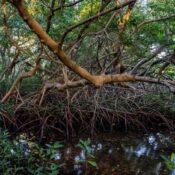
Grey mangroves are built for the difficult ground where ordinary trees struggle. Their roots sit in mud that is frequently saturated and low in oxygen, while their leaves must cope with salt and intense sun. The species answers these challenges through a suite of adaptations: underground roots spread through the sediment, pencil-like pneumatophores project above the surface to exchange gases, and thick leaves reduce water loss while managing salt taken up from the estuary.
The pneumatophores are especially important to the shape and function of a mangrove flat. Rising like small pegs through the mud, they interrupt shallow water movement and help suspended particles settle. As sediment accumulates around the root field, the foreshore becomes more stable and less vulnerable to erosion. Mangrove leaves and other organic material then add structure to the mud, supporting bacteria, worms and small invertebrates that drive the detrital food web.
Mangrove rehabilitation depends on more than planting trees. Hydrology, sediment supply, elevation, salinity and neighbouring saltmarsh all influence whether a stand will persist. Long-term local management research available through Sydney Olympic Park”s mangrove research stresses the value of baseline mapping, permanent plots and repeated monitoring. That approach matters because a healthy estuary is a moving system, not a fixed garden bed.
| Grey mangrove feature | Work performed in the estuary |
|---|---|
| Pneumatophores | Allow gas exchange in oxygen-poor mud and interrupt shallow flows |
| Salt-management systems | Help the plant survive in saline or fluctuating water conditions |
| Dense root fields | Trap sediment, reduce bank erosion and create aquatic shelter |
| Leaf litter | Feeds decomposers and supports a wider estuarine food web |
| Buoyant propagules | Enable new plants to disperse with tides and colonise suitable mudflats |
A Hidden Cradle for Fish Stocks and Estuarine Pollinators
From the water, a mangrove fringe can look modest. Beneath the surface, however, its roots create a maze of shaded pockets and low-flow refuges. Juvenile bream and flathead can use these areas for shelter and feeding, while school prawns and other small estuarine animals move through the channels and soft substrate. The tangled edge offers protection from larger predators and concentrates the small organisms that young fish need.
Much of this productivity begins with fallen leaves. As mangrove litter breaks down, it becomes part of a detrital chain involving microbes, worms, molluscs and crustaceans. Crabs process organic matter on the mud surface, small animals feed among the roots, and birds search the exposed flats as the tide recedes. Migratory shorebirds can rely on these intertidal feeding areas during their long movements, making even an urban wetland relevant far beyond the immediate riverbank.
Flowering adds another layer to the story. Grey mangrove blossoms are visited by a surprisingly diverse insect community, rather than by honeybees alone. Research documented by the Australian Museum recorded more than 170 flower-frequenting insect species in a four-season study, including native bees, wasps, beetles and flies. Many carried mangrove pollen, suggesting that this flexible network helps transfer pollen between flowers and plants. Honeybees may be conspicuous during peak flowering, but they are only one part of the pollination picture.
- Root tangles provide cover for juvenile fish and prawns.
- Leaf litter supports decomposers, crabs, molluscs and other invertebrates.
- Exposed mudflats offer feeding areas for waterbirds and migratory shorebirds.
- Native flies, wasps, beetles and bees can transport Grey mangrove pollen.
- Healthy habitat links the mangrove edge with saltmarsh, woodland and open water.
Navigational Etiquette and Best Vantage Points on the Water
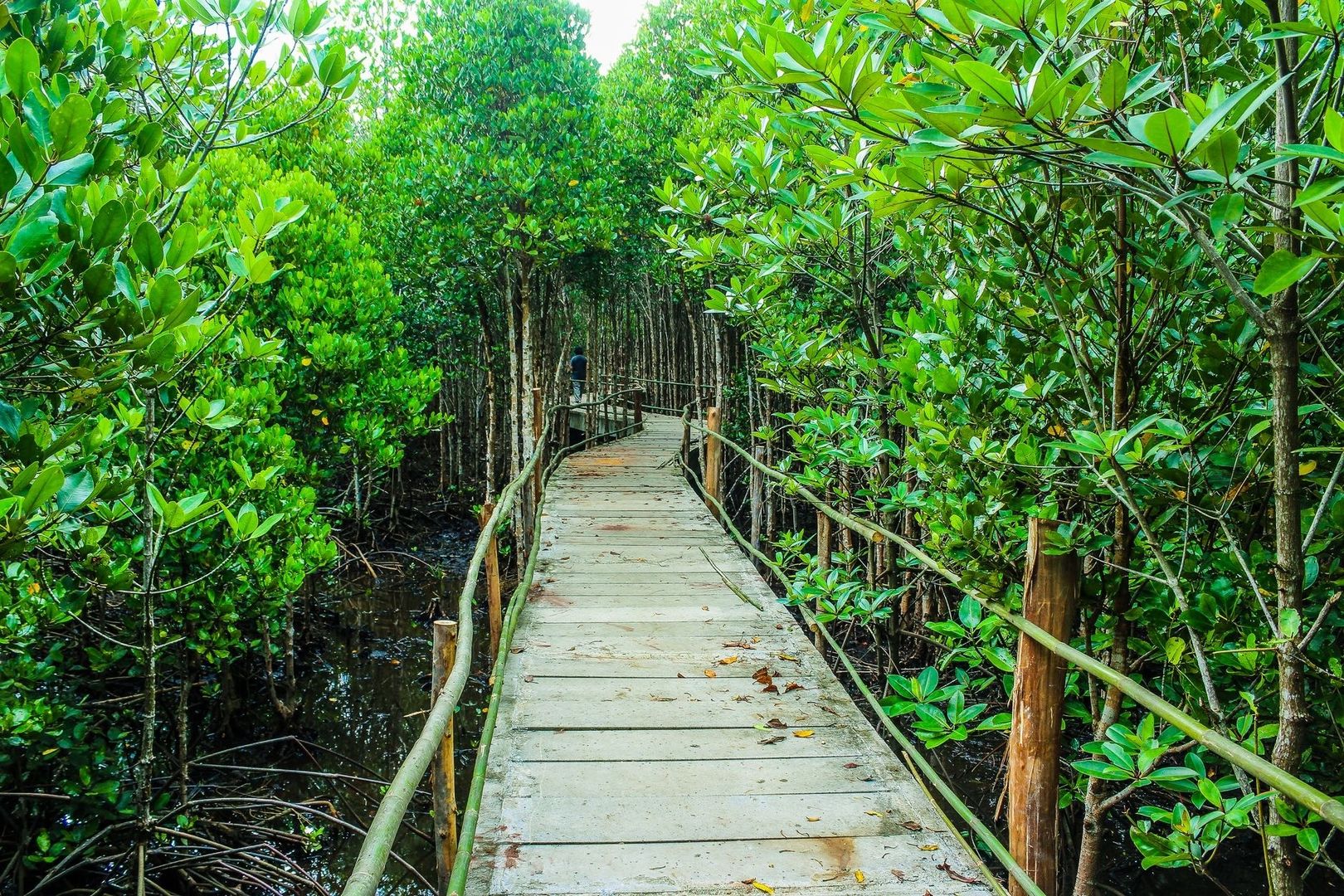
The Badu Mangrove Boardwalk is one of the most straightforward ways to examine the forest at close range without stepping into fragile mud. Located within Bicentennial Park, this elevated walkway is accessible strictly on foot. Under Sydney Olympic Park Authority (SOPA) regulations, all water-based recreation, canoeing, and paddling are strictly prohibited in the Badu Mangroves conservation wetlands, meaning craft cannot enter these channels or approach the boardwalk from the water. From the boardwalk itself, visitors gain an intimate perspective on the pneumatophore beds, the incoming tide, and the crabs and foraging birds that inhabit the intertidal zone.
To the west, the perimeter of Newington Nature Reserve provides a broader view of how mangroves fit into the estuarine sequence. Newington Nature Reserve is a gazetted reserve under the National Parks and Wildlife Act 1974 and managed by SOPA; entry into its core woodland and wetland habitats is restricted to authorised personnel. Watercraft launching or landing from or within the reserve is completely prohibited. Instead, the wetland is best observed from designated public shared paths along its perimeter, such as the Louise Sauvage Pathway and the Newington Armory tracks, which provide clear vantage points overlooking the saltmarsh and mangrove zones.
For paddlers navigating the upper Parramatta River, strict maritime regulations and tide planning are paramount. Under Transport for NSW maritime rules, the vast majority of Homebush Bay is subject to an indefinite navigation closure for all vessels, including kayaks, canoes, and stand-up paddleboards; general watercraft are prohibited from entering the bay, with exceptions limited to rowing sculls, coaching craft, and a designated 4-knot channel along the western shore off Wentworth Point. Paddlers should remain in the open Parramatta River channel and launch exclusively from designated public facilities, such as the Silverwater Park or Ermington Boat Ramps. Timing river journeys around a rising half-tide to high tide ensures sufficient water depth in the river channel and avoids grounding in soft benthic mud flats exposed at low water.
- Check tide predictions, wind forecasts, and current Transport for NSW marine notices before heading out.
- Use designated public boat ramps on the main Parramatta River, such as Silverwater Park or Ermington Boat Ramp, avoiding restricted reserves.
- Strictly obey watercraft exclusion zones in Homebush Bay and protected wetlands such as Badu Mangroves.
- Maintain a low-wake pace in the main river channel, well clear of sensitive riverbanks and mudflats.
- Carry fresh drinking water, sun protection, insect repellent, a charged mobile phone, and appropriate safety gear.
Low-wake travel and adherence to navigational boundaries protect both paddlers and recovering foreshores. In the open river, repeated wash from powercraft can accelerate bank erosion and disturb soft sediments. Paddlers must avoid entering shallow intertidal margins where paddles or hulls can crush emerging propagules and pneumatophores. On foot, visitors must stay on formed boardwalks and paved paths, leave plant material and shells undisturbed, and observe wetland birds from a respectful distance using binoculars.
Mosquitoes are part of the practical picture in warm urban wetlands, particularly around still margins and dense vegetation. Insect repellent, covered clothing and a visit planned for comfortable daylight conditions make the experience easier. Management should remain balanced, because mosquito abundance varies with land use, season and wetland condition, and not every mosquito presents a significant public-health risk. Quiet observation, sensible preparation and respect for the habitat are better guides than treating every insect as a reason to avoid the river.
Chart Your Course Into the Quiet Reaches
The upper Parramatta River”s recovery rests on two forms of persistence. Grey mangroves have used roots, leaves, seeds and tidal dispersal to rebuild living edges, while planners, scientists, land managers and community groups have restored tidal connections and monitored a complicated urban catchment. Neither process is complete, and the river still carries the pressures of stormwater, development and changing climate conditions. Yet the returning wetland demonstrates what can happen when natural regeneration is given room and supported by deliberate stewardship.
Approach the river as a living waterway rather than a backdrop. Pack binoculars, check the tide chart, review access regulations, and choose a low-impact route suited to the conditions. Whether the day involves wandering the Badu Mangrove Boardwalk on foot, cycling along the Newington perimeter trail, or taking a carefully timed paddle along the main Parramatta River channel, patience will reveal more than speed. Along this once-industrial fringe, the best journey is measured in small details: a fish slipping between roots, a crab working the mud, or a native fly carrying the next generation of mangrove pollen.